What is a tiny house?
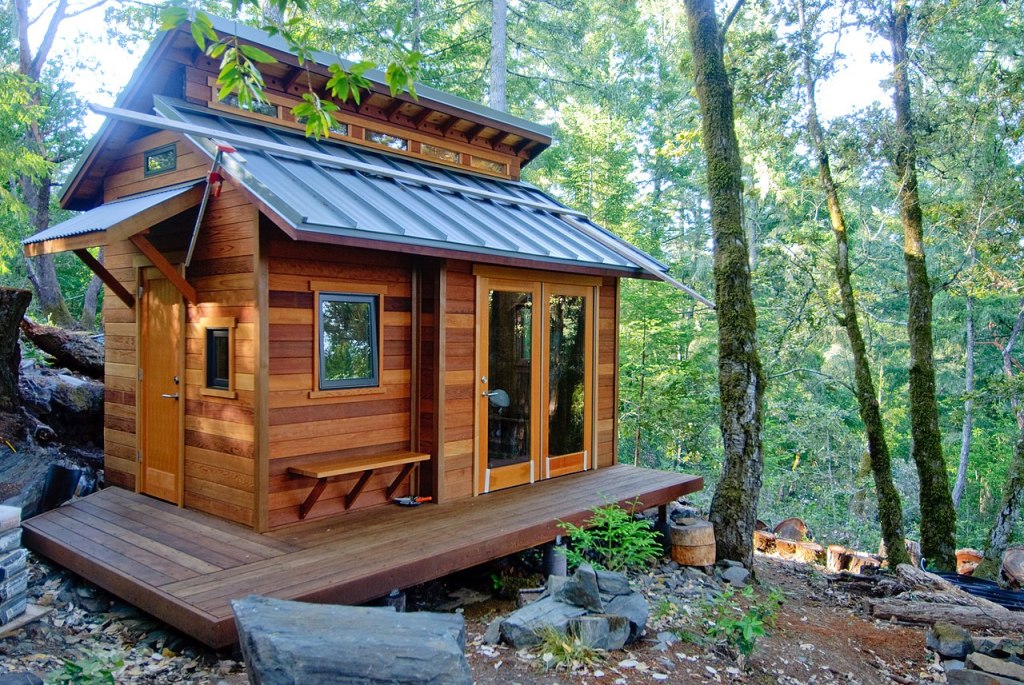
A tiny house it is a small residential structure or dwelling. It normally takes the form a building, or it can be a towable structure on wheels.
How small is a tiny house?
According to Wikipedia, tiny homes typically range between 100 and 300 square feet (9.3 and 27.9 sq metres). However, the International Residential Code 2018 indicates that a tiny house can have a maximum of 400 sq feet (37 sq metres) of floor area, excluding lofts. Other sources indicate that homes up to 500 sq ft (46 sq metres) can be accepted as tiny houses.
Why are tiny homes popular?
The tiny house movement is an architectural and social movement that advocates for living simply in small homes. Tiny homes can have multiple benefits…
- Smaller homes allow for simpler living and minimalistic lifestyles.
- Financially, they can be a more affordable way to get a roof over your head.
- Environmentally, they are seen as an eco-friendly form of housing.
- Physically, they take up less space and are transportable.
- And there is scope for tiny house communities, with shared experiences.
What are the drawbacks?
There are of course drawbacks to tiny home living (although in some eyes these are positives, or resolvable issues). Here’s a list…
- There’s less space for people and stuff, as might be expected.
- You may have smaller or bespoke versions of household appliances or furniture.
- In tiny home communities, you might be living cheek by jowl with your neighbours.
- Some detached tiny homes may be less effective at reducing heat loss during winter?
- And in the UK, you may still need planning permission…
Does a tiny house need planning permission?
Of course, most people are interested in tiny houses in order to live in them.
In England and Wales, a building or structure designed or adapted for residential purposes is referred to as a ‘dwellinghouse’ (Class C3 use). In most circumstances, a new dwellinghouse will require planning permission.
There are a few exceptions to this. There are some examples below where planning permission may not be required…
- Where the tiny house meets the definition of a caravan and it is lawfully sited and occupied (see next question)
- Where the tiny home is created by converting an existing building under permitted development rights (England), and prior approval rather than full planning permission is required. Each residential unit has to meet national space standards (including having a gross internal floor area of no less than 37 sq metres).
- Where the tiny “house” is actually an outbuilding in your garden that is used for purposes incidental to the enjoyment of the dwelling (e.g. home office, workshop) and it meets the householder permitted development rights.
What if the tiny home is a caravan?
To be honest, most tiny homes on a wheeled chassis will meet the legal definition of a caravan in the UK. A caravan is a structure designed or adapted for human habitation which is capable of being moved from one place to another. There are also provisions twin-unit caravans, and there are maximum size requirements. See our Caravans page.
How do I get planning permission?
For tiny ‘built’ homes, you could consult your local plan to see in which circumstances new homes might be supported. You could also employ a planning consultant or seek pre-application advice from the local planning authority. And there is advice on the Planning Portal (England | Wales).
For tiny ‘caravan’ homes, check out our Caravans page.
Also see our blogpost: 12 ways to get a new home in the countryside (England and Wales)
Do I need building regulations approval?
Building regulations apply to the construction or extension of buildings. A new dwellinghouse in the form of a small building would need building regulations approval.
Should your small building not be used for sleeping accommodation, it could be exempt from building regulations. Check the exemptions that apply in England or Wales.
What about tiny home communities?
Whether tiny homes take the form of small buildings or caravans, there is a lot of interest in the idea of tiny homes communities; clusters of tiny homes.
There are several tiny home groups on Facebook, including Tiny Homes UK | Tiny House Collaboration UK | Tiny House Build UK | UK Container / Tiny Homes & Off-grid / Sustainable Living.
There are also some localised groups with websites: Bristol and Exeter.
Where can I find out more?
Tiny homes are sometimes up for sale, such as on Rightmove
For the BBC perspective, see Why the tiny house is perfect for now
For a North America perspective, see All About Tiny Homes
And for the realities of tiny home living, see Insider.com
Who makes tiny homes?
You’re welcome to check out the following websites to see if anything takes your interest (not an endorsement)…
Related pages
Ideas for projects & communities (Cymru)
This page is for informational purposes only and should not be taken as advice or recommendation. It may not be comprehensive or up-to-date, and may omit important regulations, policies or criteria. You should do your own research and seek professional advice as appropriate before deciding your way forward. See website disclaimer & terms of use.

 Wildhousing