What is One Planet Development?
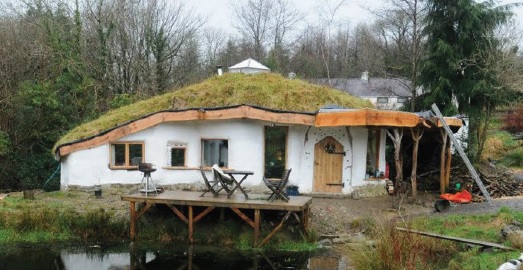
One Planet Development (OPD) is development that through its low impact either enhances or does not significantly diminish environmental quality. OPD may take a number of forms and can either be single homes, co-operative communities or larger settlements. They may be located within or adjacent to existing settlements, or be situated in the open countryside
Source: Planning Policy Wales – Dec 2018
Alternatively, in the words of the One Planet Council: “One Planet Development offers a transition to a more sustainable way of life, by providing a way for people to live and work on their own land, with measurable social, economic and environmental benefits”.
Welsh government policy
The Welsh Government’s TAN6 document states:
“Wales should use only its fair share of the earth’s resources, and our ecological footprint be reduced to the global average availability of resources – 1.88 global hectares per person in 2003. One Planet Developments take forward Low Impact Development (LID) principles in the Welsh context… One Planet Development is potentially an exemplar type of sustainable development. One Planet Developments should initially achieve an ecological footprint of 2.4 global hectares per person or less in terms of consumption and demonstrate clear potential to move towards 1.88 global hectare target over time. They should also be zero carbon in both construction and use”.
It goes on to state: “Land based One Planet Developments located in the open countryside should, over a reasonable length of time (no more than 5 years), provide for the minimum needs of the inhabitants’ in terms of income, food, energy and waste assimilation”.
The guidance states that planning applications for land based One Planet Developments located in the open countryside need to be supported by robust evidence – this includes a management plan. The management plan should set out the objectives of the proposal, timetable for development of the site and timescale for review. It should also include a business and improvement plan, a community impact assessment, and a transport assessment and travel plan.
In essence, OPD planning applications have to cover three main areas…
- sustainable lifestyle (demonstrated using an ecological footprint calculator)
- land-based productivity (food, water, energy)
- building naturally (zero carbon buildings)
For more on OPD policy and guidance, see the links further below.
Other considerations
When choosing land for OPD, factors to consider include acreage, aspect, elevation and the presence of a water supply (or other potential ways to obtain water, such as a spring or borehole).
In addition, when submitting an OPD planning application, issues that will be considered include the safety of the highway access, neighbour impact, landscape impact and mitigation, and the presence of any protected species or habitats. So worth bearing all those issues in mind.
Facts and figures
- As of January 2025, there have been 53 approved applications for OPD across Wales, comprising 56 individual OPDs (source: One Planet Council). There has been particular interest in setting up OPD smallholdings in West Wales (Pembrokeshire and Carmarthenshire).
- General advice is that a single-plot OPD smallholding requires at least 3 acres of land, and many OPDs have 5 to 10 acres. As well as space for a dwelling, outbuildings, etc, OPDs need space for domestic food growing, income-earning activities and growing timber for wood fuel.
- As a rule of thumb, farmland in Wales costs £8000 to £10,000 per acre, but this can be a lot higher in desirable areas or for small plots of land. Some established OPD smallholdings have gone up sale for in excess of £300,000. This is considerably more than the agricultural land value, but ultimately it depends on what buyers are willing to pay.
- OPD management plans tend to include several income-earning land-based activities, just in case one line of business is not as successful as originally envisaged. For a list of land-based activities that have featured in OPD management plans, see: Land-based livelihoods.
- For OPD purposes, educational and consultancy work “can be counted but must be subsidiary to the main land-based business”. It’s not possible to count accommodation (camping or B&B) towards the land-based income. Source: OPD Council.
Co-operative communities
Not all OPDs need to be single plots. TAN6 states: “One Planet Developments may take a number of forms. They can either be single homes, co-operative communities or larger settlements”.
An example of a community of smallholdings is Lammas Ecovillage – which was approved under Pembrokeshire’s (now defunct) low impact policy 52, a forerunner of One Planet Development. In total at Lammas, nine smallholdings and a community hub were granted permission. In subsequent years, other OPDs have been approved on nearby land, expanding the overall community.
The second video below features Lammas and some of the founders.
One Planet Council
The One Planet Council describes itself as an independent voluntary body supporting OPD in Wales and beyond. It “provides a bridge between applicants and local planning authorities, with guidance and tools to support anyone making the transition to this more sustainable way of life”.
On its website, the One Planet Council offers 10 good reasons in favour of OPD. It also has a webpage listing the approved applications in Wales.
In September 2022, the One Planet Council published a review of OPD in Wales 2010-2021. This found that 38 OPD sites had been granted planning permission since the policy was introduced in 2010. As reported in The Planner: “The lure of growing your own produce, building your own home and living a low-impact life in the countryside appealed to many people, but few have navigated the “daunting” process of applying for consent for such schemes, the report concludes”. The report makes a series of recommendations on how this situation can be improved.
Final remarks
The Welsh OPD planning policy offers one of the few ways people can build a new home in the countryside and establish a land-based livelihood; along with other benefits including living lightly on the planet and closer to nature. It is usually an affordable option – compared to buying an existing house with land, for example. And it offers a future less reliant on existing supply chains and utilities infrastructure, and with the added benefit of producing healthy, nutrient dense foods.
On the flip side, OPD can take a lot of research and preparation, and there is the risk that – after buying land – planning permission might not be forthcoming. A lot of hard physical work is involved with land-based living, all for a relatively low income. And some councillors in West Wales have questioned how OPD supports rural communities, and about its resource implications for local authorities.
Despite the concerns raised, OPD remains part of Welsh government policy, and is in many ways very aligned with the current need to reduce environmental impacts and support biodiversity.
Should you wish to explore OPD further, there are tours, courses and volunteering opportunities – check out the One Planet Council or Lammas Ecovillage websites.
Videos
Relevant links
Welsh Government TAN6: Planning for sustainable rural communities (July 2010)
Welsh Government Practice Guidance One Planet Development (October 2012)
Welsh Government One Planet Development Practice Guidance – ecological footprint
Welsh Government – Planning Policy Wales – Edition 10 – Dec 2018
Related pages
Ideas for projects & communities (Cymru)
AL1: Regenerative & Low Impact Development (Cornwall)
This page is for informational purposes only and should not be taken as advice or recommendation. It may not be comprehensive or up-to-date, and may omit important regulations, policies or criteria. You should do your own research and seek professional advice as appropriate before deciding your way forward. See website disclaimer / terms of use.

 Wildhousing