
What are intentional communities?
“An intentional community is a voluntary residential community designed to foster a high degree of social cohesion and teamwork” (source: Wikipedia).
Some intentional communities promote shared values or beliefs, or a purse a common vision, whilst others are simply focused on practical benefits of cooperation and mutual support. This can include sharing of community owned assets or facilities. People living in intentional communities are sometimes seen as ‘alterative lifestylers’.
There are a huge range of different types of intentional communities, including collective households, cohousing communities, co-living, ecovillages, monasteries, survivalist retreats, kibbutzim, ashrams, and housing cooperatives. Some are quite mainstream – for example a significant proportion of housing in Denmark is made up of cohousing. In some ways, cohousing – and ecovillages – can be like living in old-fashioned neighbourhoods.
Why intentional communities?
This is from the Diggers and Dreamers website…
“So you’re fed up with living in a little box. Maybe just by yourself. Maybe with your family. Just being a docile consumer alongside the billions of other docile consumers. And the combined outcome of it all is a wrecked planet. Isn’t there something more to life than this? Couldn’t we have access to many of the best things in life without doing such harm if we were prepared to share more with our neighbours? Perhaps in an intentional community – that’s a community that has come together by intention rather than by chance”.
What are the benefits?
- Low carbon lifestyles and livelihoods
- Potential for sharing resources and facilities
- Space to grow and share organic and nutrient dense foods
- Personal benefits related to health, wellbeing, education, learning and skills
- Social connection including for families with children, older persons, etc
- Scope to experiment with innovative social, environmental and economic solutions.
What are the challenges?
- Struggles to start new communities
- Social and personal issues
- Legal and financial issues
- Perception and reputation
- Lack of people and energy to sustain communities
Types of intentional community
According to Diggers and Dreamers, the main examples from the UK are…
Cohousing community – “Living fairly separately but with the possibility of sharing a lot of facilities. The best of both worlds perhaps!”
Big House community – “This is the classic idea of the commune in a big mansion in the country. Here are some places that fit that mould”
Urban communal – “These housing co-ops and big shared houses in built up areas show that not every commune has to be rural!”
Spiritual community – “Having a focus often helps. These places all have some spiritual or religious belief that underlies their existence”
Low impact community – “Many aspire to low impact living but these places go all the way with off-grid, low consumption lifestyles”
There can also be fully-fledged ecovillages – for more about ecovillages, check out the Global Ecovillage Network website.
And there can be tiny home communities – see SquareOne Villages (USA).
Examples of intentional communities
Below are three examples of rural communities in Britain…
- The Threshold Centre – A rural cohousing community founded in 2004, with a group purchasing a farm in north Dorset, obtaining planning permission and creating 14 self-contained homes, alongside a communal farmhouse. For more, see Threshold Centre website.
- Canon Frome Court – “a farming cooperative and intentional community in the Herefordshire countryside”, which comprises a country house and stable-block, which are divided into 19 self-contained homes of varying size. They say “We do not have a common philosophy, religious or political stance, though there is a prevailing sympathy with green issues”. For more see Canon Frome Court website.
- Lammas Ecovillage, Pembrokeshire – “a collective of smallholdings and eco-dwellings in Preseli hills, North Pembrokeshire. Residents explore alternative models for living on the land, broadly in line with the Welsh Governments ‘One Planet Development’ policy. The smallholdings combine traditional farming and building techniques with the latest innovations in environmental design, green technology and permaculture”. For more details, see Lammas Ecovillage website.
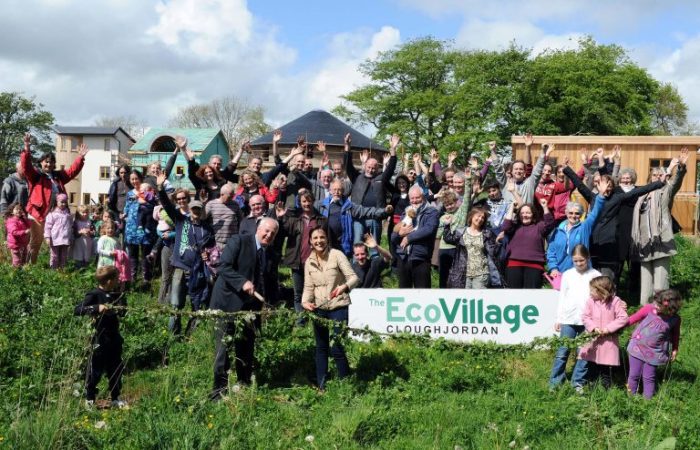
Looking further afield, there is Cloughjordan Ecovillage – effectively an eco-neighbourhood alongside a rural village in Ireland – see their website and a video here.
There are some other examples in the videos below.
Videos
External links
Foundation for Intentional Community
Global Ecovillage Network – Europe
Related pages
The social dimension (of ecovillage design)
Ideas for projects & communities (Cymru)
This page is for informational purposes only and should not be taken as advice or recommendation. It may not be comprehensive or up-to-date, and may omit important regulations, policies or criteria. You should do your own research and seek professional advice as appropriate before deciding your way forward. See website disclaimer / terms of use.

 Wildhousing